FR
FR  EN
EN DE
DE

Tiana
+86-13143789995
10 % de remise en points sur les commandes d'impressions personnalisées. Activer maintenant
Besoin d'aide ? Parlez à un expert en impression dès aujourd'hui. Trouver un magasin
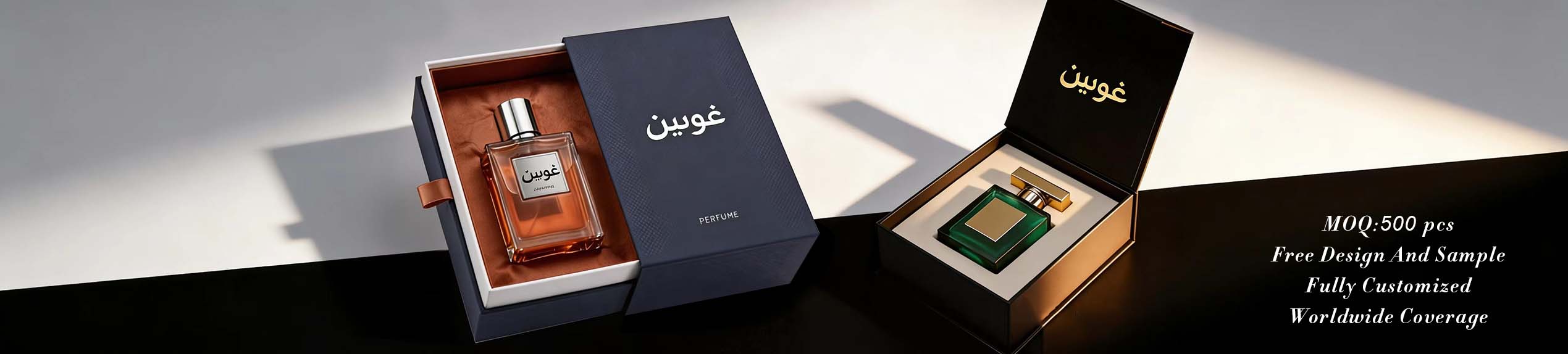
How to Choose the Right Perfume Box Structure by Product Tier
Perfume box structure should follow the product's price tier, not the other way around. This expanded guide compares book-style, drawer, shoulder, and cylinder formats with a decision table, real board grades, and indicative unit costs so you can match structure to margin.
What this guide covers
The single biggest driver of perfume box structure is the retail price tier, because structure sets both the unboxing ritual and the unit cost ceiling. An entry eau de toilette at 15 to 25 USD cannot absorb a 2.0 mm rigid shoulder box, while a 180 USD extrait practically requires one to justify the price. Decide the tier first, then pick the structure that fits the margin.
As a rule of thumb, the box should cost between 4% and 9% of the retail price for fragrance. At a 120 USD retail, that is roughly 5 to 11 USD of packaging, which comfortably funds a book-style magnet or a slim drawer but not a heavy cylindrical can with a metal base at volume.
A book-style box uses a 45° V-groove hinge at the spine so the lid folds open like a cover. Two neodymium blocks of 15 x 3 x 2 mm at N42 grade plus a steel strike plate give a closing hold above 3 N, enough to survive parcel vibration. The two-page reveal suits a 50 ml bottle lying flat with a folded insert card.
Book-style boxes need a lining and a magnet cavity, so they sit in the mid tier at about 0.9 to 1.8 USD per unit at 3000 units. Protection is good for a bottle wrapped in glassine, but the open face exposes the product to dust in transit, so an inner sleeve is advised.
A drawer (slipcase) box has an inner tray that pulls out of a sleeve. The telescopic fit needs a 1.5 to 2.0 mm board with a 0.5 mm tolerance so the tray slides smoothly without wobble. A thumb notch cut into the sleeve at 18 to 22 mm width gives the finger purchase to extract the tray.
Drawers protect better than book styles because the bottle is fully enclosed, and they feel deliberate rather than theatrical. They cost slightly more in labour because the sleeve and tray are assembled separately, typically 1.2 to 2.4 USD at mid volume.
A shoulder box (also called neck-and-lid) has a fixed inner wall — the shoulder — over which a lid descends. Built from 2.0 to 2.5 mm greyboard (1700 gsm at 0.68 density), it has the satisfying weight and a hidden reveal that signals luxury. The added board and the inner construction push cost to 2.5 to 5.0 USD per unit.
A cylinder uses tubular board with a metal or plastic base and a push-on cap. It suits solid perfumes, roll-ons, and travel sprays. Diameter tolerance is typically ±0.5 mm and the format is space-inefficient on a shelf, so reserve it for a deliberate hero or a gift trio.
Table 1 — Structure mapped to price tier with indicative costs.
| Structure | Best tier | Board (mm) | Approx. unit cost @3k | Unboxing feel |
|---|---|---|---|---|
| Book-style magnet | Mid–Luxury | 1.5–2.0 | 0.9–1.8 USD | Theatrical two-page reveal |
| Drawer | Mid–Luxury | 1.5–2.0 | 1.2–2.4 USD | Deliberate slide-out |
| Shoulder/neck | Luxury | 2.0–2.5 | 2.5–5.0 USD | Weighty hidden reveal |
| Cylinder | Mid–Hero | Tubular | 1.5–3.0 USD | Novel round reveal |
| Folding carton | Entry | 300–350 gsm | 0.15–0.40 USD | Simple open-flap |
Avoid over-engineering
Many brands request a shoulder box for a 40 USD fragrance and then lose margin. A book-style magnet at 1.5 mm board delivers 80% of the ritual at half the cost.
From the factory floor
V-groove depth should be about half the board thickness (e.g. 1.0 mm groove on a 2.0 mm board) to avoid cracking at the spine.
Magnet cavities are routed after wrapping; specify cavity depth to ±0.2 mm so the 15x3x2 mm N42 block sits flush under the wrap.
FAQ
Which structure is cheapest for a new brand?
A 300–350 gsm folding carton at 0.15–0.40 USD per unit is cheapest; a book-style magnet is the entry to premium feel at roughly 0.9 USD.
When should I choose a shoulder box?
Reserve shoulder boxes for fragrances above about 90 USD retail where the weighty 2.0–2.5 mm construction justifies the 2.5–5.0 USD cost.
Are drawer boxes more protective than book styles?
Yes — the bottle is fully enclosed in a drawer, whereas a book-style exposes the open face, so drawers need less additional sleeving.
What magnet grade holds a book-style lid closed?
Two 15x3x2 mm N42 neodymium blocks with a steel strike plate exceed the 3 N closing-hold specification used for parcel transit.
Can a cylinder replace a rectangular box for gifting?
A cylinder works for solids, roll-ons, and travel sprays and reads as a gift, but it wastes shelf and shipping cube versus a rectangular format.
Get a structure recommendation for your fragrance
Tell GooinPack your retail tier and bottle dimensions and we will spec the right perfume box structure with a costed quote.
Request a QuoteReferences


Blog Plan du site Xml politique de confidentialité
Droit d'auteur
© 2026 GuangZhou GooinPack Packaging Co., Ltd. Tous droits réservés
.  RÉSEAU PRIS EN CHARGE
Liens amicaux : Blogger
Laisser un message
Numériser vers WhatsApp :